Seeing Red


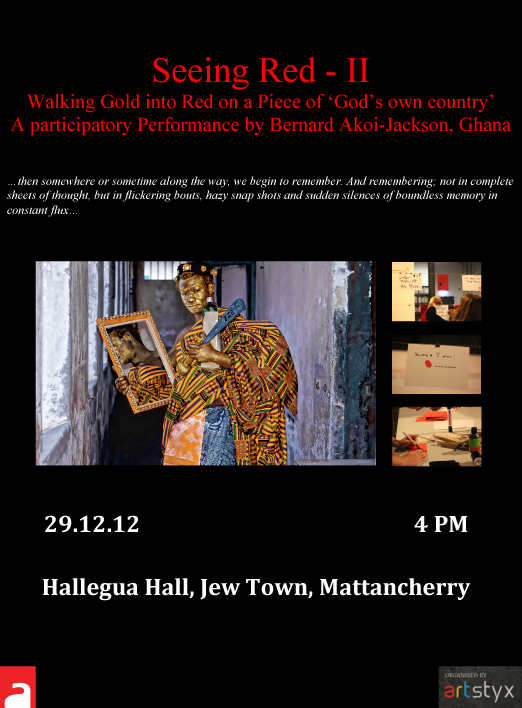
Seeing Red (II): Walking Gold into Red on a Piece of ‘God’s Own Country is a participatory performance that the artist re-enacted for the Kochi-Muziris Biennale. In this piece Akoi-Jackson walked through the streets of Fort Kochi and Mattancherry in the idealized attire of an Asante Chief. Wrapped in Kente cloth, he painted his body gold and wore head accessories similar to those that Akan chiefs wear during important rituals. He also had a headband in which cowry shells were strung together with cheap imitations of Victorian coins. Although alluding to the costume of an Akan chief, what was strikingly different was the manner in which Akoi-Jackson wrapped his Kente as a short skirt, underneath which he wore another textile that was an imitation of Dutch wax print or “Holland” as it is called in Ghana (and so similar to the fabrics that Yinka Shonibare deploys in his installation pieces, as mentioned above). In his hand Akoi-Jackson carried a mirror and a bottle of schnapps. His costume and accessories referenced aspects of colonial trade history and slavery in the Gold Coast that he and his audiences found apposite in India.
Interstices

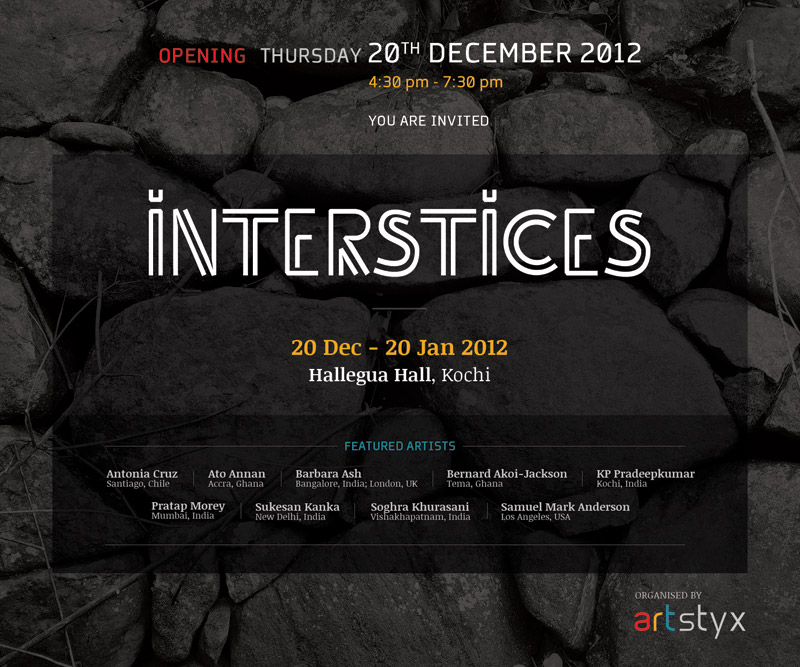
The exhibition Interstices explores the conceptual phenomenon of interstices, spaces in-between spaces, across a range of paintings, woodcut prints, photo-art, videos and installations. Removed from our everyday gaze, interstices are spaces for discourses on the gray areas in life and culture and are places of retreat amidst the madness of this world. Interstices provide an escape from the regular furor of life and at the same time offer a space hidden from authorities and hegemonic institutions in which to work surreptitiously to challenge the “rules” and “normal” behaviors. Interstices are significant reminders of the fact that often there are entities that do not fit any particular criteria or model, but rather exist as the “other” or the “marginal.” Interstices have no spatio-temporal continuity; they are rather discontinuous moments and spaces that exist as gaps in otherwise continuous and predictable systems of social realities and cultural productions. As crevices, they show what lies beneath and in-between societies, surfaces, forms, and compositions. The exhibition Interstices is an effort to present as well as discuss works of art that flourish in-between genres, mediums, practices and cultures.

Featured in this exhibition is a wide range of works created by nine artists from four different continents whose works contextually, subjectively and thematically explores the concept of interstices. Their works are interstitial as they are exploring new techniques and novel mediums, while simultaneously defining new artistic methodologies by presenting mundane subjects from radically different perspectives. Additionally, the works visually interrogate critical subjects such as displacement, disenchantment, dissolution, distortion, dereliction, disassociation and laws of disarmament. Both independently and as a corpus, the works in this exhibition question artistic disposition and enunciate the artists’ phenomenological quest to understand their artistic boundaries, personal spaces and the places that they live. Being in a state of interstiality and creating interstitial art are critical choices and positions that artists make to speak their mind.